The Slums of Heaven

The Slums of Heaven
by JS

A false god usurped Heaven
And gave way to insanity
The Absolute doesn’t do a Heaven;
Would not stoop to that inanity

The Archon sank into a black hole
Where now he spins forever
And Heaven without a Tyrant Soul
Has no organizing center

Its architecture fell apart
–no tyrant holds its kitschy shape–
Residents put cracked blocks in a cart
to cobble a shabby cityscape

The real saints left centuries ago
Jesus shook the dust off his boots
He sighed and muttered oh dear oh no
Then ascended to the Absolute

I toured the place during a N.D.E.
(Passing through several planes)
The reconstruction was done crappily
And it’s marred with dubious stains

Former saints now mutter and cough
Begging for manna on streets of gold
The golden paint is chipping off
And the air is growing cold

They huddle at fires in rusting barrels
Which formerly held cheap grace
They try to remember Christmas carols
And there’s soot on everyone’s face

Communion wine’s gulped by the crowd
They drink it like no tomorrow
They stagger past the grimy clouds
what they don’t steal, they borrow

I don’t recommend that offramp
When you’re driving the afterworld
Heaven’s slums are sleazy and damp
And the gates are no longer pearled

alternative lullabies, for naughty children.

alternative lullabies, for naughty children.
#1
The Great Gray Larva

When you’re ready for sleep,
whisper to the light
ask that the Great Gray Larva
won’t visit you tonight

it waits till you sleep
till your eyelids drop
then creeps and slides
to harvest its crop

though it’s ever so big
it is supple as smoke
to slide under the door
to visit small folk

and oh the marvels
and oh the sights
of the Gray Gray Larvals
when we dim the lights

but if you take care
to think good thoughts
there’s a good chance
you won’t be caught–there’s at least some chance
you won’t
be
caught

He failed to pass the teaching along?

GURDJIEFF: Mysticism, Contemplation and Exercises
By Joseph Azize
Oxford University Press 2020
Reviewed by John Shirley

Years ago, I wrote a letter to Colin Wilson, the prolific writer on the paranormal, to thank him for his book The Occult, purely because of the book’s capacious section on Gurdjieff. He had provided a reasonably good precis of some central Gurdjieff teachings, and I was excited to recognize notions that were part of my own viewpoint on life: that we are asleep when we think we are awake, that we are mostly mechanistic in our responses, having very little objective control over what we do; that we are so deeply identified with the series of trances, of states, that consume our lives, we’ve lost touch with the purpose of living. Inspired by what I’d read, I searched for Gurdjieff, found his advocates, and learned a great deal more, which was of enormous benefit to me. But I did take issue with one observation of Wilson’s—he claimed that Gurdjieff had failed to pass his teaching along, in any powerful way, to his pupils. The common fallacy is that Gurdjieff had no methodology; that he had only shocking ideas to work with, so he couldn’t teach anyone how to reach his level.
Nothing could be farther from the truth. Great exponents of Gurdjieff’s Fourth Way, like Lord Pentland, Michel Conge, Michel de Salzmann, William Segal, the late Jean-Claude Lubtchansky, and—most especially—Jeanne de Salzmann, attained to profound consciousness through the Gurdjieff Work. Many of their students developed into fine teachers of this fusion of Eastern and Western esoteric teachings. As for methodology, it is the core of Gurdjieff’s teaching. Gurdjieff did not say that we’re in this awful state implacably or hopelessly. He said that we there is a way out; there is a praxis leading to real consciousness, inner freedom, and higher being. Only—it is hard and unsettling work.
Until recently, the methods were nearly all passed along orally, in person, with teachers of a Gurdjieff group. This is a time-honored means to keep an esoteric school relatively pure. A few methods were offered for public consumption, in Gurdjieff’s unfinished work, Life is Real, Only Then, When I Am; certain others, such as the practice of intentional suffering (not as scary as it sounds), can be found in allegorical form in his gigantic tome, All and Everything: Beelzebub’s Tales to His Grandson. Works by his followers, like Maurice Nicoll’s “Psychological Commentaries”, provided some scant samplings of his methods.
But in recent years two books have emerged to offer the general public real, fairly in-depth entry into the actual methods Gurdjieff used. The first is The Reality of Being by Jeanne de Salzmann. That superb book dismayed some of the more hidebound Gurdjieffians with its limpid exposition of Gurdjieff’s methods. The second has come upon us this year, and it may be equally controversial in Gurdjieff circles: Joseph Azize’s thoughtful exegesis, Gurdjieff: Mysticism, Contemplation, and Exercises.
The book is constructed in three parts: Introductory, Gurdjieff’s Contemplative Exercises, Exercises from Gurdjieff’s Pupils. Azize derived these techniques largely from transcribed talks by Gurdjieff and some of his more important students. He has also shown how some of them dovetail with known practices of esoteric Christianity.
Part I fills readers in on highlights of Gurdjieff’s life, so far as it’s known. and while his biographical sketch contains a few lapses into unconvincing speculation, it’s on the whole quite sound. It also contains “An Overview of Gurdjieff’s Ideas” in which Azize niftily and handily lays out many of the Fourth Way’s anthropological, esoterically psychological, and cosmological complexities.

A New College Creation Concept

I believe that a new way to create universities must be conceived and put into motion. The current universities are unaffordable. Students are saddled with crushing debt.

New accreditation, acceptable by prospective employers post university, must be implemented for a new form of college. All colleges/universities must be nonprofits and must be free or close to free, for students. The universities should pay teachers/professors well, within limits. No money for sports unless through donations.

Or, college level sports can be a separate industry: You can go to school in the new style university, then go to practice at a commercial facility where, if you’re chosen, you are paid to play sports for entertainment, to the degree you have the time.

This new style of higher educational institutions could be organized in cells–small campus spaces that are rented and outfitted in several parts of a city. Donated spaces will be sought. Costs could be crowdsourced and subsidized by states, cities and philanthropy. Eventually, if we get a non-corrupted administration back, subsidization could come from the federal govt. But the feds would have to accept the concept: Accreditation for no appreciable cost.

Difficult to get good professors, for this? Lots of professors and teachers have difficulty getting work. This will give them another opportunity.

Free schools were tried, but they tended not to have accreditation. We need a new movement for reforming accreditation for valid new educational structures so that costly colleges die on the vine.

Alternative higher education can be designed and built. Start with one, show it works.
Two things more, at this early stage: NO AI TEACHERS, NO AI USE BY STUDENTS. It has to be the original style of teaching, as in the best schools, but with modern standards for racial and sexual equity. And ideally there should be an alternative form of providing textbooks. Notoriously, standard textbook publishing is a scam that gouges students financially. New textbooks, new publishers for them, new deals cut for old ones and used ones.

The dick state of mind

The choices of the dick state of mind
resonate through the ages
the dick, the jerk, the sullen state of mind
the passive aggressive rages

The dick, the jerk, the selfish state of mind
concatenates through the eras
from all that happened in London
to all that happened in Paris

to all that happened in New York
from that time in Chicago
to all that happened in Cork
ramifying its farrago

The choices of the dick state of mind
resonate through the ages
the dick, the jerk, the sullen state of mind
the passive aggressive rages

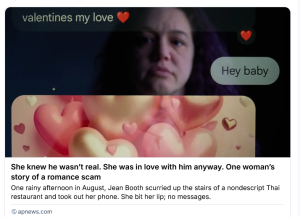
Romance Scams and Misinformation addiction- What happens to people?

As per the FBI: In romance scams, a criminal uses a fake online identity to gain a victim’s affection and trust. The scammer then uses the illusion of a romantic or close relationship to manipulate and/or steal from the victim. The scammer wants to establish a relationship as quickly as possible, endear himself to the victim, and gain trust. Scammers may propose marriage and make plans to meet in person, but that will never happen. Eventually, they will ask for money.

How do people fall for romance scams? When they realize they’ve been scammed, victims are often puzzled, themselves. “How did I ever get taken in by that? Am I just stupid?” No–you were vulnerable. Victims of romance scamming are not necessarily unintelligent.

Maybe people who are desperately lonely essentially cancel out some of their own intelligence, in service to that desperation, without knowing they’re doing it. They surrender to a more credulous state of mind, making them vulnerable to addictive dopamine-hit manipulation.

Similarly, some people on some social media, needing a feeling of connection to something they supposed powerful, will unconsciously submit to misinformation, in return for the feeling of safety and satisfaction it can impart. They become stupider, yes, for a time–conditionally stupid. It can go on for a long time, because the quick pleasure jolts, through flattery and promises from the scammer, are continuously addictive. As people slip here and there about the internet, they come upon the reiteration of the big lie, whichever big lie it may be, and each time they see it the tendency to believe it is reinforced, both by the feeling it gives and the impact of sheer repetition.

Of course we’ve always seen phenomena of this sort in gold fever, or in gambling fever: otherwise intelligent people tossing away money in the service of addiction to the attendant highs. Now, with the internet, the phenomenon has reached a new form, and new heights (can one have ‘heights of debasement?’), as in the new power of disinformation, due to the web’s technological ubiquity. The Big Lie can come from many directions at once and can spread much faster. Lies can go viral. The scammers have more access to their victims, and more anonymity to protect themselves. A scammer meeting you in a bar would have to wait, to get you to take great sums out of your bank and get them to him. But now money can be disbursed from your bank account in seconds–before you have time to change your mind. Social media and other internet formats have exponentially amplified the power of lying. The “gold fever” of cryptocurrency–often disastrous for investors–is also spread by the internet’s multi-pronged power of persuasion.

Unlike misinformation scammers, the parasitical sleazebags targeting romance scam victims on the internet reiterate and repeat their counterfeit courting linearly, for the big set up until the right moment has come for, “Darling I just need a thousand dollars to come to you…Send it quickly or I’ll never be able to contact you again…” Addicted to neurological pleasure hits from being cossetted and coaxed and groomed over and over, the victim is ready to comply.

Convenience is Doom

Convenience is Doom
1.
Plastic is so convenient;
it chokes seas, collects within us–
Gas engines, so convenient;
they choke the skies, they fall to rust–
Pesticides, RoundUp, so convenient;
they choke our wells with toxic spume;
Smothering malls–so convenient;
Face it: convenience is doom.

2.
They came to us smiling,
wonders in hand,
convenient material,
sleek as a rocket:
so shiny, so easing,
the design is tres grande:
even computers
you carry in pockets;
hypnotic screens,
chargers in sockets;
each new gift
was a phase in their mission:
now they’ve trapped us
into a prison.
So get used to your room:
Convenience is Doom.
–J.S.

We Think We Know Ourselves but–We Don’t

What is meant by the ancient Delphic maxim Know Thyself? Do we know ourselves?

“Oh yeah, I know myself”, he said. “I know I like red meat and I don’t like fish. I know I like Christmas more than my birthday. I know I like chocolate more than vanilla. I know I like baseball but not football.”

“Sure I know myself,” she said. “I know I like to wear blue and I don’t want a spouse who snores and I don’t like sad movies and I do like comedies and I know that when it comes to pets, I totally don’t like parakeets…”

And so on. But all that isn’t what is meant by the maxim “know thyself.” Sure, it’s knowing something about yourself. But it’s like comparing the view from snorkeling along the top of the water to the view from a submersible at the bottom of the sea.

Even many of the ancients didn’t fully grasp what Know Thyself meant–to most of them, it probably meant “know your limits and possibilities”.

Sure–know those things. But that self knowledge is only the tip of the iceberg.

In the 4th century BC Plato expanded the meaning of the maxim to “know your soul”. The sages who speak of self-knowledge interpret Plato as meaning: See yourself as you truly are. Know the deeps of your unconscious, which is the key to discovering your spiritual possibilities and spiritual infirmities.

To know oneself requires a particular kind of self-observation, which is empowered by self-honesty. And self-honesty is powered by a deep desire to understand why one does what one typically does–and what one typically doesn’t do. “Now why the hell did I do that? Why didn’t I have more patience? Why didn’t I think it through?”

With objective self-observation, taught in certain schools of spirituality, in several traditions, one discovers the blind selfishness we didn’t know we had. One discovers the deviousness, the dishonesty we didn’t even know we were using. One discovers that one is more fear-driven than supposed. One discovers how asleep we’ve been to ourselves, going through our lives like sleepwalkers. One discovers that we’re normally caught up in machine-like reactions to the world, based on neurosis, conditioning, fear, trauma, sheer habit. Through self-observation one discovers deep psychological motivations, hidden emotional triggers, and how many more possibilities there are for conscious choices.

There are many, many more choices, in our response to the world’s input, than we suppose. With self-observation we see them at last, and learn why they were hidden away…

“When you know yourselves, then you will be known, and you will understand that you are children of the living Father. But if you do not know yourselves, then you live in poverty, and you are the poverty.” Jesus of Nazareth, quoted in The Gospel of Thomas

Gaia’s Quite Angry With Us. She has a prophecy.

Gaia’s Prophecy
By John Shirley

The human crowd is chattering
Unhearing men trade flattering;
Those ever speaking cannot hear
The voice of the Unseen One near

But quiet ones hear the unheard
Echolocation bears their words:
Spirits of trees, the spirits of mammals;
Animis Mundi of all animals

Spirits of caverns, spirits of sea:
Their moaning cries call out to me–
They mourn the loss of mermaid daughters;
Of fish and whales, dolphins and otters

In forest is heard the lamentation
For creatures lost in mass extinction;
And birds are dying as insects vanish,
Seeds are gone or cease to nourish

At last is come sweet Gaia’s answer
She flicks a finger at the cancer:
“The humans corrupt with greed and hurry
“Have turned the seas to plastic slurry

“They choke Poseidon, and elementals,
“Burn up nature’s fundamentals;
“More than locusts, more than mold
“They gulp and blight all they behold

“But harken to this prophesy:
“Their works will fall to entropy;
“Humanity will consume itself:
“A new extinction on the shelf;

“My kaleidoscope will whirl in glory
“And up will rise a newborn story:
“Nature returns to sanity—
And I won’t bring back humanity.”

AI FUCKED UP THE COVER ART OF MY BOOK – And I had nothing to do with it

The original publication art from Kensington was fine–this is from a Thorndike Large Print book version.. Look at this monstrosity! Look at his hands, his holster and gun! Look at his STUPID HAT. And look at the deformed head of the guy on the left! Of course I’ve complained to Gale/Thorndike, haven’t heard back. If you know anyone at that publisher please let them know about this blog post. And I got a letter from a librarian about it–I despise AI art anyway, and I totally agree with her.

Mr Shirley:
I work at a public library and we purchase many large print books from Thorndike Press from Gale. We recently purchased your 2022 Cleve Trewe Western trilogy from them. I was quite saddened to see that the cover of Axle Bust Creek was AI generated “art”. When I saw this, I searched to verify that it wasn’t written using AI. I began to research you, and from what I can tell, you do not appear to support the use of AI. I’m not sure how much control authors have over things like this, as I am just beginning to learn about the publishing industry and I am still very naive on the subject. I wasn’t sure if you were aware and I felt like you may want to know that your work was being sold with an AI cover. I apologize if this is not of concern to you, as I don’t wish to waste your time. But as a human, a consumer, and a reader, I believe the use of generative AI “art”, especially in the publishing industry, is an issue of the utmost importance. I have included a scan of the cover for you to see.
Thank you for your time and happy writing.
– Ashley Phillips