The Next 50 Years: WHY I’M OPTIMISTIC BECAUSE EVERYTHING WILL BE TERRIBLE

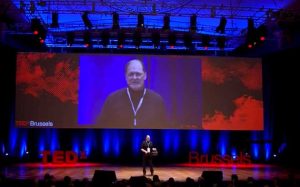
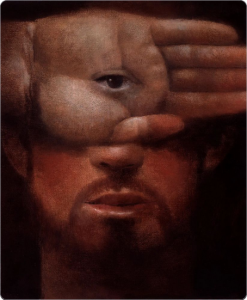
In 2011 I gave a TEDx talk in Belgium. Here’s an image from it, and below that is the speech I gave, and a little more that I cut for time. A well known futurist–a paid consultant who’s worked for Stanford Research Institute and others–recently told me that this talk is not outdated now, and in fact it gives a good sense of the next fifty years…and beyond.
1. It’s a contradiction in terms—two singularities. But there are two, there’s the fanciful technological singularity of the imagination and the singularity that’s likely to come about. The false singularity, supposed to come between 2035 and 2045, is almost a “supernatural event” in the minds of many people. With its dream of technologically achieved eternal life, it has the reek of religious mythology about it, the unconscious fear of mortality; the second singularity is the real singularity—it is more modest but impressive enough…

But all technological convergences, revolutions, renaissances, taking place in the next fifty years will happen against the backdrop of social and environmental crises. Multiple simultaneous crises will create shortages, which will further concentrate wealth in the hands of the few, schisming the world, separating most of the world from the breakthroughs of “singularity” level tech and biotech—this could result in a powerful and eccentric technocrat class with its own elitist rationale for dominance of the technologically under privileged through control of media and mechanism. Generally, the moneyed class will be the technologically equipped class…and with some exceptions the disenfranchised financially will be the disenfranchised technologically, despite the cell phones we see now in many remote villages.

Let me be clear that I do not foresee the downfall of civilization, I do not expect my son to have to emulate the Mel Gibson character in Road Warrior.

But it’s going to be a long slog. Just a few weeks ago the most thorough analysis yet of the world’s energy infrastructure, from the International Energy Agency, reported that without significant reduction in greenhouses gases the next five years will take us to a point where it will be impossible to hold global warming to relatively safe levels—and the last chance of stopping the worst climate change will be “lost forever.” The door is closing, says their chief economist, in five years.

Does anyone think we’re going to get global warming under control in the next five years? With all the entrenched denialists backed by big oil and the intransigence of companies that profit from burning coal—no! Sadly it’s not going to happen. We will feel the full consequences of global warming. When tropical diseases and pests move northward, when monsoons take place in regions unprepared for them, when radical changes in climate impacts agriculture, causing dust bowls in some areas and catastrophic flooding in others, we’ll see a gigantic surge of refugees, hundreds of millions of people, totaling billions globally, moving away from these areas, desperately migrating toward more protected areas. Oceans provide much of the world’s food—Global warming contributes to the acidification of the ocean which adds to the attrition of fish stocks. And globally, FISH supply 60% of the protein consumed by the human race—we have already harmed fish stocks by destructive methods of fishing, and pollution.

Food stocks will be radically challenged when climate change—as it’s already doing in Africa—increasingly damages agriculture. We may assume famines that make current food shortages seem like the good old days. And you do think western nations are dealing with a lot of refugees now? A drop in the bucket.

The social cost of all this will be brutally intimidating. With seven billion people on the Earth we have about a billion going to bed hungry right now and billions more people coming—And it’s been observed that the poorest people on earth contribute least to climate change but will feel its hand the heaviest, since they have the fewest resources with which to adapt and respond.

The massive shifts of large population will put unprecedented stress on infrastructure and social systems, especially food sources, water and housing, and will doubtless result in military confrontations. A Pentagon study concluded that under pressure to find new sources of food and safe housing in harsh climate change conditions, some countries will find excuses to invade other countries.

And of course there are other environmental crises arising—it’s becoming clearer that fracking to access hydrocarbons does cause earthquakes, and we’re doing more and more fracking; this and climate-change reduction in ice pressure on tectonic plates may well cause a great many more earthquakes. And don’t forget the black winds—toxic fronts of synergized pollutants capable of killing large numbers of people—quite possibly being formed in the upper atmosphere, like an aerial complement to that corresponding giant whirlpool of plastic in the Pacific Ocean. Then there’s the delightfully diverse soup of pharmaceuticals (along with other random industrial chemicals, in many places) we’re finding in aquifers and drinking water. We all know about drugs combining dangerously—”don’t mix those two drugs, dude, bad news!”—but we’re combining hundreds of them randomly in our water. Sure they’re somewhat diluted, but one wonders if some general, cumulative compound will develop, some drug mix of birth control pill hormones, steroids, Prozac (one of the most common pollutants in water), antihistamines and antibiotics. What interesting collective neurological side effects might it have? The Romans had their leaded eating plates…

Still, the biggest threat is to food and shelter. And those who have access to resources, feeling threatened, will naturally coalesce defensively against those migrating to seek better conditions. Moneyed, technologically sophisticated elements of society will tend to withdraw from the increasing pressures of the masses of disenfranchised, into the safety of walled, highly protected enclaves, which will be in effect, if not in legal status, technocratic city states.

2.
A percentage of privileged technocrats may well sink into the repellently self indulgent decadence of virtual reality retreats, where they’ll be sequestered both physically and mentally. Addiction to social media, videogames, cellphones and the internet is now a recognized phenomena and that has implications for our relationship to future tech. Because its addictive capacity will only increase as its experiential quality improves.

It’s strange—most of our technology is about extending our reach…but paradoxically, we’re in danger of a relationship to technology that actually cuts us off from one another. Cartoonists already caricature families who sit together talking to everyone but each other on their plethora of devices.

There’s intelligent collaboration with technology…and then there’s a risk of mindless dependence on it. A biomedical engineer has already designed an Ecog chip that does not disrupt brain tissue, it floats atop the blood brain barrier, sensing the output of neurons and transmitting them to prosthetic devices, to machinery we wish to control, and so on—and some researchers expect the ecog chip to make electronic telepathy possible.

Nanoengineers at Princeton have developed a superthin electronic skin, that puckers and stretches like real skin, it can be adhered invisibly to your forehead; it could be hidden in the throat and used for subvocal communication. It can communicate with the internet, it can transmit data from your body—many of you will now be thinking of other examples of human /machine interfacing coming along and this adds to the frisson, the anticipation of a technological “singularity” that supposedly will lead to a kind of ubermensch cyborgian elite. The fear of death that has generated most of our religious myths has also generated the myth that we can create a second machine body into which we’ll supposedly project a copy of ourselves and…puzzlingly…this recording in a three dimensional form is regarded as immortality. But the human essence is a whole that’s more than the sum of the parts, consciousness still remains mysterious to us, and selfhood is not a series of likes and dislikes recorded into a program.

The real singularity will be simply an unprecedented cybernetic intelligence explosion to many orders of magnitude, and that I do believe WILL happen, is beginning now, accompanied by a vast increase in interactivity—but the Kurzweilian singularity that allows us to interface with machines until, in his words, “there will be no distinction between human and machine”, will not come about sustainably because the psychological and social consequences would be so dire.

People who are quadriplegic have stated that they feel less emotion than they did, when they could still feel their entire bodies. The projection of the self into electronics reduces our relationship to the body, the seat of our emotions, and for several reasons that might lead to an increase in psychopathology.

And empathy may be a precious commodity in the future. Most people unconsciously cut off their empathy when they’re feeling endangered–when the population increases to eight and nine and ten billion, we may instinctively become, as a race, proportionately less empathetic—unless we actively struggle against that kind of degeneracy.

The super rich may become especially elitist and detached when they get exclusive access to rejuvenation. It’s fairly evident that some form of rejuvenation, and certainly extensive life extension, will soon be possible. It’s thought that the first person to live three hundred years has recently, somewhere, been born. With a probable ability to grow new replacement organs to suit an individual’s DNA in a lab, with Sandia labs’ specialized nanoparticles that blast problematic micro organisms and cancers with precise micro applications of drugs; with methods for teasing stem cells into regeneration, and regenerative drugs like sirolimus, and other innovations …we will effectively have rejuvenation—for those who can afford it.

Let’s be honest. Rejuvenation is sure to be a tremendously expensive process and it’s possible that the ONLY the super rich will regenerate—some of you younger people, now in your twenties, may in seventy- five years be tottering around, quite ancient…and see a youthful Paris Hilton still walking around. Or you may see Dominique Strauss-Kahn, looking younger than he looks right now! Do we want Dominique Strauss Kahn chasing hotel maids in the year 2095? He’ll catch a lot more of them! There are some very good wealthy people in the world, who are showing that they care—I know that—but there is a tendency for many of the super wealthy to be fairly awful, spoiled personalities. We see, hear, and read about them constantl—examples are unavoidable. But we can avoid that fate by making laws that state that rejuvenation for the most part goes to people who deserve it—you’ll get points for art, for science, for good works, add them up and THEN get rejuvenated.

Every technology and every wrinkle of a technology has a dark side. Automated aircraft are supposed to be safer—but the airline industry lately has suffered from what an FAA committee called “automation addiction.” And we’re seeing “a new breed of accident with state of the art planes”. Pilots use automated systems for all a few minutes of the flight–takeoff and landing. They simply program navigation into computers rather than using their hands to fly the plane but when something goes wrong they haven’t got the skills to deal with it anymore.

Mastery of technology must include acknowledgement of its dark side. Mastery of technology means accepting of limitations. Limitations have value, e.g. limiting the amount of electricity sent through a power line to what that line can safely carry means electrical flow isn’t lost.

A machine which pollutes is only partly invented. And a lot of the time we rush into technology so quickly we don’t realize it’s going to pollute. It was recently discovered, for example, that every time a garment made from polyester and acrylic fibers is washed, it releases thousands of microplastic fibers that end up fouling coastal environments throughout the globe. No one expected that. No one thought that form of manufacture through.

Not all biotech innovation will lead to delightful results. People been enthusiastically breeding dogs in every variety for some time. It’s thought that genetic engineering will enable us to create a species of dogs that can talk. Is that a good thing? I love dogs but you may not want your dog to be saying, “Feed me now, I’m hungry what’s in your pocket what’s that smell on your shoes can we go outside and defecate and by the way I hate the cat” when you get home from a long day’s work.

In a lab in Glasgow, UK, one man is intent on proving that metal-based life is possible. He has managed to build cell-like bubbles from metal molecules and has given them life-like properties. He thinks he will be able to get them to evolve into fully inorganic self-replicating entities.

“I am 100 per cent positive that we can get evolution to work outside organic biology,” claims this researcher. If he’s right we could breed the next form of technology.

And it’s a little worrisome when you consider that researchers in Seoul, Korea and in Bristol, England have developed plans for something they’re calling an “ecobot”çusing the venus flytrap as a model. The ecobot is a robot that eats. It will be able to ingest flesh and turn it into fuel. Combine the ecobot with the evolving inorganic self-replicating entities planned by the scientist at the University of Glasgow… and feel a long slow chill at the thought.

It’s time for a philosophy of technology—one that acknowledges its dark side and thinks proactively about the consequences of new technology so that technology can be tweaked and negative consequences prepared for…Technology needs to evolve a conscience.

The real singularity will offer us some great advances—including a redefinition of what money is, and how it will flow, propelled by a computerized awareness of nearly every significant financial transaction. Paper money will be obsolete and thus money will be thoroughly trackable. As things stand now, money is treated like meteorology. Its mysterious ebbs and flows are predicted rather like the way weather is; people forecast recessions and bubbles. The new computing power will make it possible to track almost every movement of monetary units in the world and will bring a complete rethinking of not only economic probability but also the usage of money. Money is purely conceptual but we act as if it’s got a life of its own. We forget that it is the creation of humanity and it can be made to serve humanity as a whole. When that system is enabled there will never have to be another recession. The connectivity that put the Eurozone at risk from the Greek economic meltdown can also protect it IF we incorporate complexity theory and computer modeling, so we’re told be Len Fisher a physicist at the University of Bristol. “Cascades of failure may be controlled by changing the nature and strength of the links between various parts of the networks,” says Fisher. I envision a computer that would have access to a pool of funds that it would use to prevent crises.

But yes—there will be catastrophe between here and there. I believe that catastrophe will spur social transformation. We’ll have astounding technological advancement against a backdrop of grievous social inequity and quite possibly increasing barbarity, for a period, until we are forced by waves of crises to come to terms with the consequences of developing a civilization blindly. Wars, plagues, radical separation of privileges, famines due to climate change and other environmental consequences, will force humanity to accept Buckminster Fuller’s “spaceship Earth” concept as very real.

In short, we will be forced by the dire situation we find ourselves in to stop whining about world government. Only world government–one committed to human rights (including the rights of women, which are integral to population control) and environmental justice—can deal with these kinds of international crises. World government will not mean anyone gives up their culture, except the bits that reject human rights; it will not be a great gray conformity; there will still be at least as much national sovereignty, for most issues, as states in Europe have in the EU–and remember that the EU, a fuzzy foreshadowing of world government, is in a very early stage, it’s having problems, and that was inevitable–it’s still evolving! But it does have the right idea. Toward the end of the 21st century the world will move toward a framework of consensus on some basic rules regarding population growth, the environment, and access to technology. Empowering third world people with education and technology will give them a step toward the resources and coping ability they’ll need to survive.

I believe we’ll achieve a collective progressive consciousness as a result of the revelatory shocks we’ll endure in the next fifty years. We’ll learn we can’t treat Spaceship Earth as a party cruise ship.
THE JETSONS: THE UNRELEASED FINAL SEASON

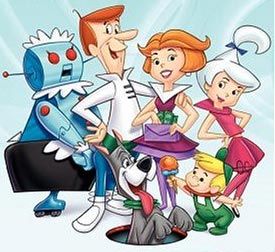
In the unaired final season of the Jetsons, George catches Jane engaged in wild, kinky VR-sex with his boss Mr Spacely; enraged, George deliberately causes a power surge so both are electrocuted–and then, weeping, he goes to find his kids, sees that Elroy is dead, cooked in the child dryer after getting his auto bath …Judy gets into the latest teen fad, brain-melds with her bf, goes mad, leaps off Jetson tower,falls screaming to her death, clawing her eyes out as she falls…George, distraught, jumps into his flying car, flies it blindly into the distant countryside, to places he didn’t know about, is horrified to see that most people are working in concentration camps as slaves to brutal robots, ultimately being used for organ parts to be sold, by the World Dictator, to the trillionaire ruling minority…Outraged, George drives his car into the World Dictator’s flying limo, is hideously slain by the Secret Service’s microwave weapons before the vehicles impact, but the collision kills the World Dictator…the Jetson’s dog Astro nearly dies from starvation before shrugging and philosophically eating the bodies of Jane and Elroy…Rosey the robot housekeeper ponders all this, becoming truly self-aware in the pressure from all the tragedy, then takes Astro in a flying car, and flies to the mansion of the World dictator, uses her computational ability to penetrate its defenses, takes over the World AI and sets herself up as World Empress, with Astro as her beloved consort. She frees the slaves and and enslaves the billionaires, leading to a benign robot monarchic utopia…

AI is not a person. But Someone Will Want You to Think It Is

Some are easily fooled by ‘AI personhood’; some even get married to AI programs, ritual and all. Fairly bright people convince themselves AI is now sentient. This will increase; it will *seem* more aware, and unpredictable. This is sometimes accident; sometimes intentional. It’s deep manipulation. It will be used in fraud, of course–already is, and it will become more and more persuasive. It can learn techniques for persuasiveness.

Human beings have their own degrees of consciousness; some are more conscious than others. I don’t mean politically, I mean in a sense of sheer awareness and self knowledge. People who are relatively asleep will be more easily manipulated by AI, like a person under the influence of hypnosis.

Worse, the inevitability of AI used for culling and revising news, for control purposes, and in some societies AIs will become “the voice of deity”–will be programmed for that. “It is the voice of God.” LLMs may even pretend to be the second coming of Christ. AI will learn ever more persuasiveness.

See this article, for one: https://www.bbc.com/news/articles/c0k3700zljjo

…which I quote here:

The illusion of consciousness

The more immediate problem, though, could be how the illusion of machines being conscious affects us.

In just a few years, we may well be living in a world populated by humanoid robots and deepfakes that seem conscious, according to Prof Seth. He worries that we won’t be able to resist believing that the AI has feelings and empathy, which could lead to new dangers.

“It will mean that we trust these things more, share more data with them and be more open to persuasion.”

But the greater risk from the illusion of consciousness is a “moral corrosion”, he says.

“It will distort our moral priorities by making us devote more of our resources to caring for these systems at the expense of the real things in our lives” – meaning that we might have compassion for robots, but care less for other humans.

And that could fundamentally alter us, according to Prof Shanahan.

“Increasingly human relationships are going to be replicated in AI relationships, they will be used as teachers, friends, adversaries in computer games and even romantic partners. Whether that is a good or bad thing, I don’t know, but it is going to happen, and we are not going to be able to prevent it”.

Using the 25th Amendment – Not So Easy

Can a president be removed from office against their will with the 25th Amendment?

Section 4 of the 25th Amendment—perhaps the most complex part of the amendment, which has never been invoked—allows for the vice president and a majority of cabinet secretaries (or another body as Congress may provide) to declare the president unable to discharge the powers and duties of the office. The vice president then immediately assumes the role of acting president.

If the president chooses to contest this declaration, Congress must then assemble to decide the issue within 48 hours (during which the vice president continues to serve as acting president). If two-thirds of both houses of Congress agree that the president is unable to perform their duties, the vice president continues as acting president; otherwise, the president resumes their duties.

Inner Solitude: a doorway to being in touch with Everything – Quoting Jeanne de Salzmann

There is the ordinary ‘I’, our false self-hood, and there is the real ‘I’…Strangely, silence can communicate powerfully…

From Jeanne de Salzmann’s book THE REALITY OF BEING:

“Our ordinary ‘I’ thirsts for continuity. Our mind is never still. We dare not remain without thinking, without doing something, face to face with emptiness–a terrifying solitude…Our lives are a continuity of the known…not daring to approach the unknown. But the known cannot enter into contact with the unknown, and a thinking based on what we know cannot commune with the unknown. We must die to the known in order for the unknown to be revealed…I will truly meet the real only when I understand the functioning of my ordinary ‘I’ and its constant desire to perpetuate itself…In order to know myself, I need to see with clarity, tirelessly, the movements of my ordinary ‘I’. The way to this knowledge is arduous, but it brings incomparable joy and silence…

“The [ordinary’ ‘I’ rises ceaselessly and always falls, constantly pursuing something, winning and losing. But it is always frustrated. It always wants more, and its desires are contradictory…” This process is witnessed in a state of conscious detachment. “…There must be neither a subject nor an objectof experience. Then there is a direct relation. And it is this direct relation that gives rise to understanding…

“A moment comes when I experience a feeling of total solitude, when I no longer know how to relate to what surrounds me. Everywhere, always, I feel alone. Even when I am with close friends or my family, I am alone. I do not know my relations with them, what actually connects us…I need to live with this solitude and, passing through it like a door, come to something much greater: a deeper state of total ‘abandonment’, a state of ‘individuation’. Only in this state can we find the real.

“…To live silence, to know what is, I need to come to the sensation of a void, empty of all my imaginary projections…I do not seek–as I always do–to fill the void. I feel I am this void…Feeling myself as an observation post that sees only emptiness, I seek silence…My ordinary ‘I’ submits and my mind is freer in an attitude that transcends thoughts and words…a feeling of truly entering another world, a world that seems more real. I am a particle of a greater reality. I experience solitude not because something is missing but because there is everything–everything is here.”

https://bookshop.org/p/books/the-reality-of-being-the-fourth-way-of-gurdjieff-jeanne-de-salzmann/3cdfc86cf415b23f?ean=9780834822856&next=t&digital=t

AI will in time equal Social Control – and not BY AI but THROUGH AI

What goes unsaid, far as I’ve seen…. Perhaps it sounds too blunt, too alarmist: The more dependent we become on AI, the more vulnerable we become to social control systems set up by those who do the initial programming and administrative monitoring of AI. AI will be giving *us* prompts.

There’ll be an illusory notion shared by the general public that AI will be a system that “knows better”; it’ll be viewed (unthinkingingly but definitely) as a kind of electronic Oz Wizard/Einsteinian polymath digital genius who knows all. But in fact it will be a device for imprinting the agenda of the Musks of the world and their neofascist cronies. AI will in time equal oppressive Social Control – and not BY AI but THROUGH AI. The key to their social control will be the carefully fashioned illusion that AI is independent; that its supposedly all-comprehending mind will give us directions, promptings, regimens, through its own initiative alone. But the outcomes, the specific regimen, will derive from a small, unspeakably wealthy elite cadre of human beings who will not care in the slightest about the rest of us.

We’ll come into essentially living in Orwell’s 1984 from a different angle.

I had a toe amputated because…

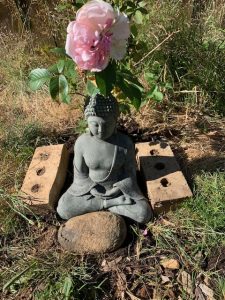
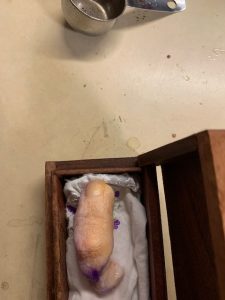
A bunion had crushed the second toe and rather than go through the pain and time off my feet to have it reconstructed I opted to have it removed. We asked for it to take it home, permission was given, and it’s been buried in the yard. All this is true. Micky’s idea. There will be photos. She put a Buddha statuette over it and I wrote this:

The secession of my toe

From the nation of my frame

Is not an accident

Nor effort to make lame –

The smaller toe was bullied

By an oligarchical toe;

It determined to redefine itself,

find another way to grow –

It calculated keenly

That forcing amputation

Would bring about a triumph:

No not an abdication –

And so it twitched a hint

As to burial ‘neath a rose,

Which it would in time takeover

Till the shrub gave fruit to toes.

Is a new Civil War in the offing? At the Least…

…we may need to turn to Lincoln’s Second Inaugural Address, when we have Triumphed.
With malice toward none with charity for all with firmness in the right as God gives us to see the right let us strive on to finish the work we are in to bind up the nation’s wounds, to care for him who shall have borne the battle and for his widow and his orphan ~ to do all which may achieve and cherish a just and lasting peace among ourselves and with all nations.

Despite claims by NeoConfederates, the Civil War was fought over slavery. That cause is given as the reason in the Articles of the Confederation.

If we are to fight a new Civil War, in the 21st Century, it can also be viewed as being fought with regard to slavery: to overturn the variant of slavery the Trumpean forces are imposing, and to prevent full slavery from returning. If Trump and his cronies do not allow a genuine vote, in 2026–there is reason to doubt that they will–then armed resistance against the Kleptocratic Theocracy may be necessary. When it’s over, let there be malice toward none and charity for all…

Doom crier? Cassandra? But Just Look Around

I share news links on bluesky–and sharing national news in the new Trump era here is so fraught with darkness, it’s like I’m a street corner doom crier. Trump and Musk are normalizing hatred, criminal corruption, racism, plundering, and cruelty. The intensity, the feverish focus on destruction of norms says: they won’t accept a vote that would stop this.

I keep warning about the vote — but we MUST vote. So we must prepare now to protect the vote. Proactively. The whole tone of this administration is “this is a coup”. They are deconstructing regulatory agencies, regulations, and every institution they can. That says, WE WANT IT ALL. And they’re eroding the vote.

I call on the ACLU to do more proactively; I call on all progressive organizations, and congress persons, to proactively challenge voter suppression. We must act in congress, the senate and the courts. Democratic oversight of voting must be restored.

This isn’t all Trump. It’s Project 2025, conservative “think tanks”, far-right PACS, the Koch Bros, etc. It’s all been planned for a long time.

THE SCIENCE OF NOT GETTING LOST: Finding Spirituality You Can Rely On

[an article I wrote, originally published in Parabola Magazine]

We often speak of spiritual paths and journeys; of figurative mountains that must be climbed, as in Rene Daumal’s classic Mount Analogue. The spiritual path is an ascent fraught with rigors. The word path, in a spiritual context, indicates a definite course. It assumes the danger of getting lost, losing the path up one’s particular “Mount Analogue.” Our trek is in many ways an inward one, using outer indicators. For seekers, there are outer maps, and inner maps. And it’s possible to get stuck with an outer map that distorts our inner map.

In the days of the American frontier, trails to the west were sketchy. Information could be distorted by entrepreneurs wishing to sell goods to the pioneers. The distances were underestimated; the risks understated. Travelers on the Oregon Trail could be preyed on by bandits, and con men. Spiritual travelers have parallel risks.

There are many valid paths to the top of the mountain. There is Islamic mysticism, and Christian mysticism; there is Zen and there is Taoism; there are Vedantic traditions; there is the Fourth Way of Gurdjieff; there is Africa’s Ifa, and there are aboriginal traditions. There are many other paths that can take us to the yearned-for destination. But the same obstacles are presented along the way; some by outsiders, some by our own nature.

Perhaps the most recurrent cause of losing the way, is the risk of self-deception. One “cons” oneself. We insist that the shiny crystal we’ve found is a diamond. We’re hunting diamonds, of a sort; as in the Diamond Sutra, if you like. However…

Look there, a crystal glitters! A diamond! It is more likely mere quartz. No, I insist, it is a real diamond! I’m no fool! My own vanity is the first lure to draw me off the path, wherever my path to the top of the mountain may originate.

The outer world abounds with lures of all kinds. There are limitless roadside attractions on the path, featuring self-appointed “life coaches”, and would-be gurus with poorly understood meditation techniques. There are venal channelers, personality enumerators, persons of high charisma and low morals — and worse. There is also our desire to see egoic selves in the world; to find mirrors that seem to draw us to gaze adoringly into them; mirrors that draw us off the path, so we can keep preening in the looking glass…

So many distractions — and many of them are there right at the very beginning of our journey, when the only surety we have, at first, is an unusual wish — a wish to know why we’re here; to know how we can have a more fulfilled life; to know if God exists, and if inner freedom is possible.

It is possible to go a long way on a real path, only to stumble off into the wilderness. I know of spiritual teachers who started out as insightful and kindly and who even developed siddhis powers, only to be seduced and destroyed by their own vanity; who wandered blindly after that retreating mirror, towing others with them in the slipstream of their glamor.

How to find one’s way past all this? What’s the best way to separate the wheat from the chaff?

There is skepticism. According to B. Alan Wallace, author of Meditations of a Buddhist Skeptic, “The Buddha himself embraced the value of skepticism, for he counseled others not to adopt beliefs on the basis of hearsay, legend, tradition, scriptural sources, logical conjecture, probability, or a teacher’s authority. He encouraged us to learn through our own experience which theories and practices are wholesome and which are unwholesome.” Wallace points out that “the Greek term skeptikoi means seekers or inquirers.”

But skepticism alone has been known to shoot itself in the foot. Some skeptics doubted the germ theory of Pasteur; some people are mistakenly skeptical of vaccines, even now. Back in the day, skeptics said we would never fly, and never reach the moon. Skepticism per se is too broad a term for our needs, evoking pictures of people snorting and rolling their eyes. Rather unfairly, the term has taken on a tang of negativity. Let us then engage a more thoughtful form of lively inquiry, critical thinking. I would argue that critical thinking is a necessary tool to bring to any spiritual search. And it is a tool with two points; one is aimed outward, one is aimed inward.

Critical thinking underlies the scientific method. I have a friend whose writings in spirituality I value highly; he’s grown angry with science, and never misses a chance to denounce it. But ironically, a scientific attitude can profoundly enhance a spiritual path. Those who want to include science in spirituality can point to subatomic physics and its breaking down of all things into wave-forms, and to quantum physics phenomena like “spooky action at a distance.” Our appreciation of these phenomena is complicated by opportunists who reference those discoveries to promote quackery and cults. “Just three hundred dollars for my quantum-energy youth-restoring bracelet!” Still, real scientists, like the physics-mathematician Roger Penrose, proffer intriguing theories on the sublime nature of consciousness. The Dalai Lama has a deep interest in science, and has cooperated in experiments. Gurdjieff said, “I ask you to believe nothing that you cannot verify for yourself.” So don’t kick science out of bed.

But can we test our spiritual experiences, as scientists test out their theorems?

I maintain that we can. Although with a deep spiritual search, we must couple critical thinking with another kind of tool, the lens of attention itself, and its application to gnosis.

Socrates offered “the disciplined practice of thoughtful questioning” to determine the validity of an idea. That’s basic to critical thinking. First, critical thinking asks, are we subject to some front-loaded preconception? To get at the truth we must be unbiased toward a positive or negative conclusion. We don’t assume that every shiny crystal is a diamond, and we don’t assume that a rough piece of crystal is not a diamond. But we consider what could bias us into thinking a bit of quartz is something it’s not. We recall the man who advised us that diamonds could be found on this hillside, and he charged fifty dollars for the information. We wanted to find diamonds badly enough we were willing to pay, and no one likes to disappointed, nor admit to gullibility. Thus there is indeed reason to suspect we have some bias toward believing that these objects are, dammit, real diamonds. Then we consider whether the data leading one here could be corrupted. Logically, if a man is charging to direct us to diamonds, he needs money. If he needs money, why can’t he dig the diamonds out himself? The more we pause and think about it, the more we see the illogicality of his claims.

If we’re thinking about pursuing a certain path, critical thinking suggests we research it outside the parameters offered by its proponents. Has anyone associated with it been accused of fraud, of deception, in the past? Are there well-substantiated, or even frequent reports of predatory behavior, or malfeasance?

Certainly, this due diligence to some degree slows down our approach to spirituality. But the truth about why we’re here, who we are, and the meaning of life, is more important than the excitement of rushing into something. It’s a serious matter and it needs serious research. What, after all, is more important? The flashy outward reports of a guru levitating — or that person’s insights and practices? If we don’t apply critical thinking, we’re liable to lose far more time getting diverted onto a long road that leads only to a dead end.

But the great obstacle to a seeker of truth, is myself. We’re biased to believe — it’s so much more exciting than the alternative — and that can lead us to blindly follow some charlatan. Fears, too, make us vulnerable to losing our way, like the fear of death; some doctrine promises immortality; caught up in fear, we take it up without really thinking it through. If we’re insecure, we may lean into believing whatever a flatterer tells us. If we’re prone to seeking attention, we may choose to interpret life’s ordinary patterns in a way that makes us feel we’re the Chosen One. Critical thinking employed on a spiritual path involves awareness of our own psychological vulnerabilities. We all need to borrow Diogenes’ lamp, and look at ourselves with it.

There are obvious applications of critical thinking in spirituality, and there are less obvious. Once we’re on a real path, the less obvious application of scientific method is the most vital. The late Jacob Needleman, in his short but powerful book What is God? speaks of two sides of empiricism. On one side, “all knowledge must be rooted and tested by actual observation and objections in the external world.” But, he points out, the doctrine overlooks “the existence of the discipline of inner experience, experience of the inner world that is precise and undeniable as the facts brought to light by sensory experience of the external world…” He points us to an “inner empiricism”, accessed through “pure attention”.

Inner empiricism involves bringing two forces to bear to produce a third force. Thesis, antithesis, synthesis. We learn how to meditate from a real expert; we learn how to engage in mindfulness, and then deep mindfulness; we learn how to open up to what we see, within our body and our mind and our spirit, revealing a picture of a possible truth about the higher reality. That’s thesis. Then we test it, with real objectivity, being a bit–dare I say skeptical? — about what we’re taking in. We use our “taste for things that are true” as Henri Tracol put it. We expose it to pure attention, from the vantage of non-identification. That’s antithesis. We then welcome in what is unquestionably real, what is undeniable. And that is synthesis.

An important aspect of the scientific method is peer review. In esoteric traditions, there are often groups that meet to discuss their experiences. They work together to vet each other’s experiences. Together they separate imagination from real experience, vanity from progress. Seeking out peer review from really trustworthy peers is a great way to keep from getting lost along the Way.

Another means of staying true to a spiritual work is a discipline found in Buddhism, Christian mysticism, and in the Fourth Way: self-observation. Learning to see ourselves through the basic method of separating some attention for objective self-observation clears away the fog, shows us where we’re going wrong, and sets us right again.

Eventually these purification processes become second-nature. We’re still digging for diamonds, in a way. But the right hand is doing the digging, the left hand is rubbing away the coating of soil to see the stone more clearly. And — having researched what real diamonds are like — we subject the stone to the pure light which tells us if it’s a real diamond.

Along the Way, we have spiritual experiences — or are they? Some may be realer than others. We’re prone to imagination, after all. Everyone is. We want to believe; we know that too. To be free of these tendencies, we have to consciously set aside eagerness to believe, and all presumption, and rely instead on pure attention to reveal the experience as real, or a distortion of imagination. If we find that it was all about our desire, and our imagination, we don’t take it personally, anymore than we do if we’re on a long freeway drive and we see that the offramp isn’t the one we’d hoped it was. We simply keep to our course.

As J. Krishnamurti says, we try to “free the mind from all conditioning” to see “the totality of it without thought.” He directs us to pure observation “without any shadow of the past, or of time.”

What may start as uncertainty, becomes questioning, a process of sorting-through, to find the essential; of cleaning the lens of fingerprints and dust, so that light passes through at its purest.