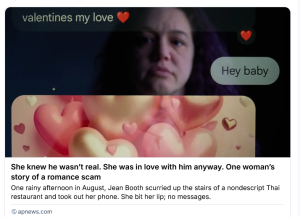
As per the FBI: In romance scams, a criminal uses a fake online identity to gain a victim’s affection and trust. The scammer then uses the illusion of a romantic or close relationship to manipulate and/or steal from the victim. The scammer wants to establish a relationship as quickly as possible, endear himself to the victim, and gain trust. Scammers may propose marriage and make plans to meet in person, but that will never happen. Eventually, they will ask for money.
How do people fall for romance scams? When they realize they’ve been scammed, victims are often puzzled, themselves. “How did I ever get taken in by that? Am I just stupid?” No–you were vulnerable. Victims of romance scamming are not necessarily unintelligent.
Maybe people who are desperately lonely essentially cancel out some of their own intelligence, in service to that desperation, without knowing they’re doing it. They surrender to a more credulous state of mind, making them vulnerable to addictive dopamine-hit manipulation.
Similarly, some people on some social media, needing a feeling of connection to something they supposed powerful, will unconsciously submit to misinformation, in return for the feeling of safety and satisfaction it can impart. They become stupider, yes, for a time–conditionally stupid. It can go on for a long time, because the quick pleasure jolts, through flattery and promises from the scammer, are continuously addictive. As people slip here and there about the internet, they come upon the reiteration of the big lie, whichever big lie it may be, and each time they see it the tendency to believe it is reinforced, both by the feeling it gives and the impact of sheer repetition.
Of course we’ve always seen phenomena of this sort in gold fever, or in gambling fever: otherwise intelligent people tossing away money in the service of addiction to the attendant highs. Now, with the internet, the phenomenon has reached a new form, and new heights (can one have ‘heights of debasement?’), as in the new power of disinformation, due to the web’s technological ubiquity. The Big Lie can come from many directions at once and can spread much faster. Lies can go viral. The scammers have more access to their victims, and more anonymity to protect themselves. A scammer meeting you in a bar would have to wait, to get you to take great sums out of your bank and get them to him. But now money can be disbursed from your bank account in seconds–before you have time to change your mind. Social media and other internet formats have exponentially amplified the power of lying. The “gold fever” of cryptocurrency–often disastrous for investors–is also spread by the internet’s multi-pronged power of persuasion.
Unlike misinformation scammers, the parasitical sleazebags targeting romance scam victims on the internet reiterate and repeat their counterfeit courting linearly, for the big set up until the right moment has come for, “Darling I just need a thousand dollars to come to you…Send it quickly or I’ll never be able to contact you again…” Addicted to neurological pleasure hits from being cossetted and coaxed and groomed over and over, the victim is ready to comply.